



Companies, investors and regulators are doubling down on their commitment to environmental sustainability, even in the face of global conditions putting pressure on the energy sector, according to ANZ GE, Institutional Mark Whelan.
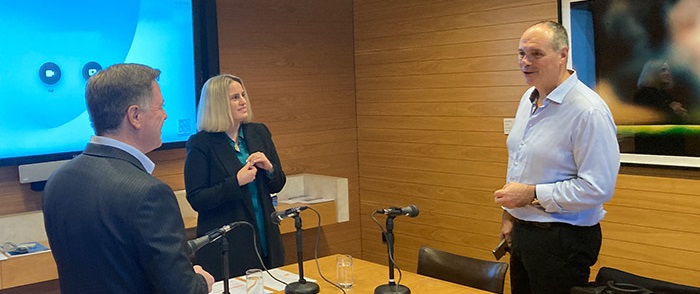
Speaking with BP Australia President Frédéric Baudry, Whelan said a recent trip to Europe, where he spoke to customers and other stakeholders about environment sustainability, showed him the transition to net-zero carbon was only gaining momentum.
While European national governments are shoring up energy supplies and seeking alternatives to Russian gas, the European Union has launched a massive expansion of renewable-energy construction by boosting funding for projects.
“With recent issues in Europe and what that's done to energy prices, you would think there may have been a weakening in the approach to the transition,” Whelan said of his trip. “If anything, it's completely the opposite. I'm seeing a doubling down from all those stakeholders… in the transition. And I think that's a positive.”
Energy markets face challenges in the short term but the medium- and longer-term outlook is strong, according to Whelan. He noted a broad recognition of the benefits in supporting customers committed to transition.
“If anything, I think you're going to see significantly more investment in renewables at a much faster rate than what we'd anticipated,” Whelan said.
The conversation came shortly after BP announced it has agreed to acquire a 40.5 per cent stake in the Asian Renewable Energy Hub in Western Australia’s Pilbara region. You can hear an edited version of the conversation on podcast below.
{video}
Whelan said there was recognition in Europe that the market Australia had a major role to play in supporting the push to net-zero around the world.
“There is an expectation Australia is going to be at the forefront of this transition and many of our customers and they want to participate in that,” he said.
Baudry agreed, noting the country’s enviable supply chains for energy positioned it well compared to some of its international counterparts.
“I fundamentally believe [Australia] should be aspiring to be, and it will be a renewable energy superpower,” he said. “Australia has natural, abundant renewable energy that can be developed at scale.
“It has world-class infrastructure; it has world-class human capabilities that have played a role in the energy and resource sectors and made them incredibly prosperous in this country.”
Owning it
Baudry said it was critical for businesses across the energy supply chain to recognise and act on their role in the transition to net-zero.
“Energy companies like BP have to own the problem, have to be part of the transition, and have to play a part in providing the solution”, he said. “We’ve set out a net-zero ambition and we're now making concrete investments in service of that.”
A successful transition will require companies with the capability, will and investment to help completely reimagine the energy system, according to Baudry.
For Whelan, these are not attributes businesses will always be able to secure on their own. ANZ has partnered with climate investment and advisory group Pollination for this reason, he said.
“One of the things that became obvious to us as a bank very early on [in the transition] was no company would be able to do this by itself,” Whelan said. “Partnerships are going to be critical in this transition.”
Whelan said the number of parties involved in the AREH project with BP was clear evidence of this.
“You need different skills, you need different finance tools, you need different capabilities,” he said.
Baudry agreed, noting the need to build “capabilities in each of our organisations to make those concrete investments come to fruition,” complementing and supplementing capabilities among partners.
“There's a very high dose of humility that is required as we enter this,” he said. “Because it is uncharted, because there are trillions of dollars in investment required to plumb the energy system.
“What we need to do is bring together is a coalition of the willing - working with customers, with funding partners, with governments, to establish a policy framework that enables Australia to meet its own environmental targets in a way that works.”
Building
Momentum in the environmental sustainability space continues to build, according to Whelan, “and it’s building because people are seeing real, practical examples of [successful environmental] sustainable investment”, he said.
“The investment we're seeing, coming through governments and into other areas like in infrastructure, I think is critical. That makes it real.”
The experts also talked in detail about BP’s investment in the renewable-energy hub in the Pilbara, how each company hopes to work with its partners through the transition, and how the conversation with customers has shifted from the risk associated with the transition and toward the opportunity.
Listen to the podcast above to find out more.
